Product Requirement Management (PRM) is the cornerstone of product management. Yet in every project that I ever got involved, the choice of tool and process for PRM always caused heated discussion. You’ll find everyone (seriously I mean everyone: sales, engineers, executives, and product managers) has an opinion and the discussion quickly evolves into a tug of war among multiple parties.
IMHO, that’s exactly the core of the problem: PRM is a holistic problem involving multiple parties, and each party has different needs.You can’t let one party make the decision. An efficient PRM process needs to address majority , if not all, of the stakeholders’ needs. In other words, as a product manager, you need to perform requirement management of requirement management before doing anything 😉
So how to design a good PRM platform? Let me put my key points up front. then we’ll dive into where these conclusions are drawn from.
- Let engineering team use the project management tool of their choice! Pick an PRM tool and Integrate it with the engineering project management tool.
- Pick a PRM tool that:
- give customers and sales proper visibilities. The key word here is access control and dashboard.
- offer dashboard and reports for executives.
- enable online collaboration & communication.
- assist release planning, which a given.
There are tons of PRM tools out there. Just to name a few that I ever laid hands on:
Use cases
- Customer
- A single place to submit feature requests. If the customer purchases multiple products from a company, which is often the case in the enterprise space, it’s especially important to have a single place for customers to file requests for all products.
- Track the request progress: What is the status of my requests? When can I expect them to be delivered?
- Product roadmap: What is the product roadmap? Does the product has a committed plan? How can I influence the roadmap?
- Product manager
- Release planning & tracking
- Track & notify stakeholders: for each requirement and notify stakeholders when requirements change
- Collect detailed requirements. This
- Executives
- Project progress:
- Stakeholder status: are customer requirements get address timely?
- Product roadmap:
- Engineers
- Release planning & tracking
- Backlog
Features
- Online: The RM tool has to be online! It has to enable collaborations among various roles! Forget about any kind of document that needs to be shared through email.
- Collaboration: Access Control (RBAC): when field communications is involved, RBAC becames critical, e.g. customer A shouldn’t be able to see the requests from customer B; engineering team need to be protected/shielded from the field team
- Workflow engine: each product has a unique way to process the requirements.
- Filters/views referrable with URL: This a high valuable feature that is very often neglected.
- Links
- Planning tools: Batch process
- Integration with engineering tool: many engineering teams are very adament about what tool they want to use for project management.
The ideal RM solution in my opinion should have 2 parts
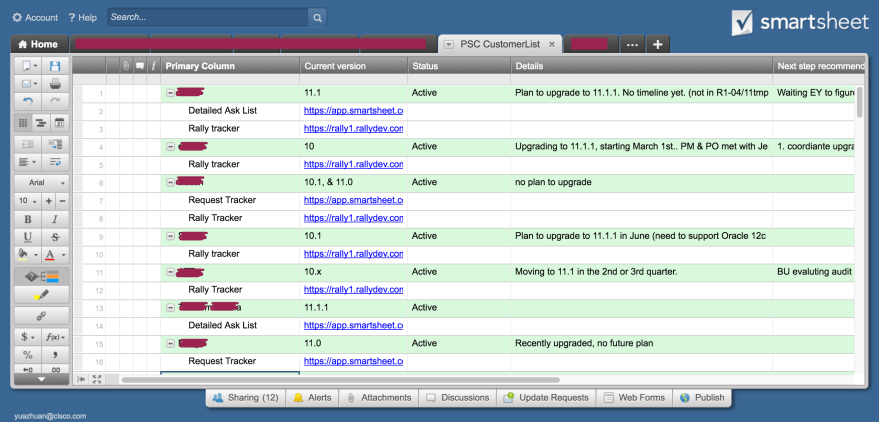
- Dashboard for various stakeholders (Wiki, SmartSheet, …)
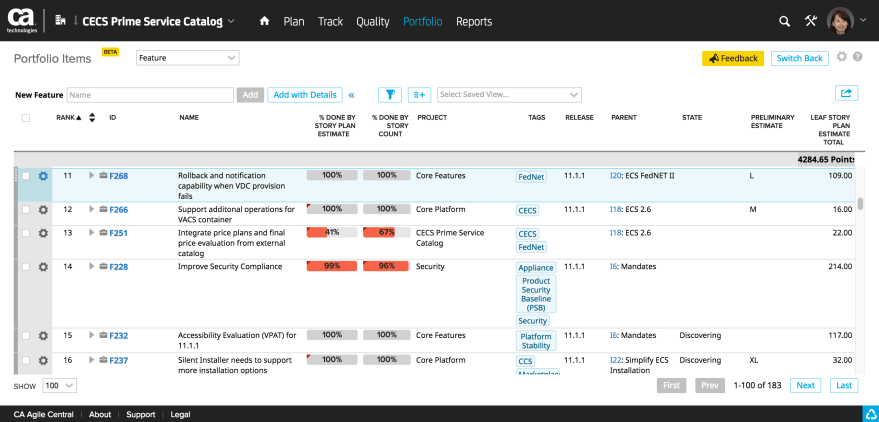
- Backend documents datastore (JIRA, JAMA, Rally, Smartsheet, Taiga, Doors, ReqPro, … this list can go on forever)
A Chart
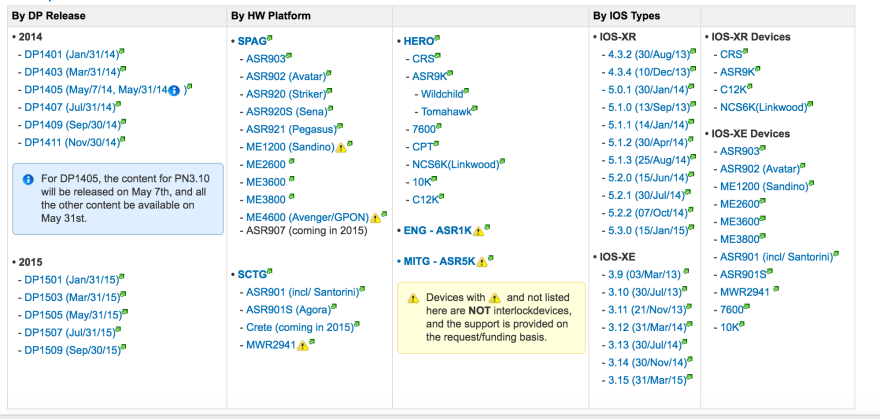
Here’s a requirement management solution I built for Prime Network (PN), a network management solution that manages with thousands of network gears. PN’s main challenge is to deal with large variety of routers/switches:
- 30+ product families, 100+ models, 6-7 software upgrades every year;
- Interlock with 10+ engineering teams that build the routers/switches;
- Demanding customers – large account with leading service providers;
Each link

Dashboard: SmartSheet
Datastore: Rally
JAMA

Last but not least, be aware that RM is a live animal. It requires constant care and attention: feed it with new requirements, groom it using ,
 Maggie's Odyssey